Robotics / Physics-Informed Neural Networks / Webots

UR5e True PINN IK.

A physics-informed inverse kinematics solver for a 6-DOF industrial robot.

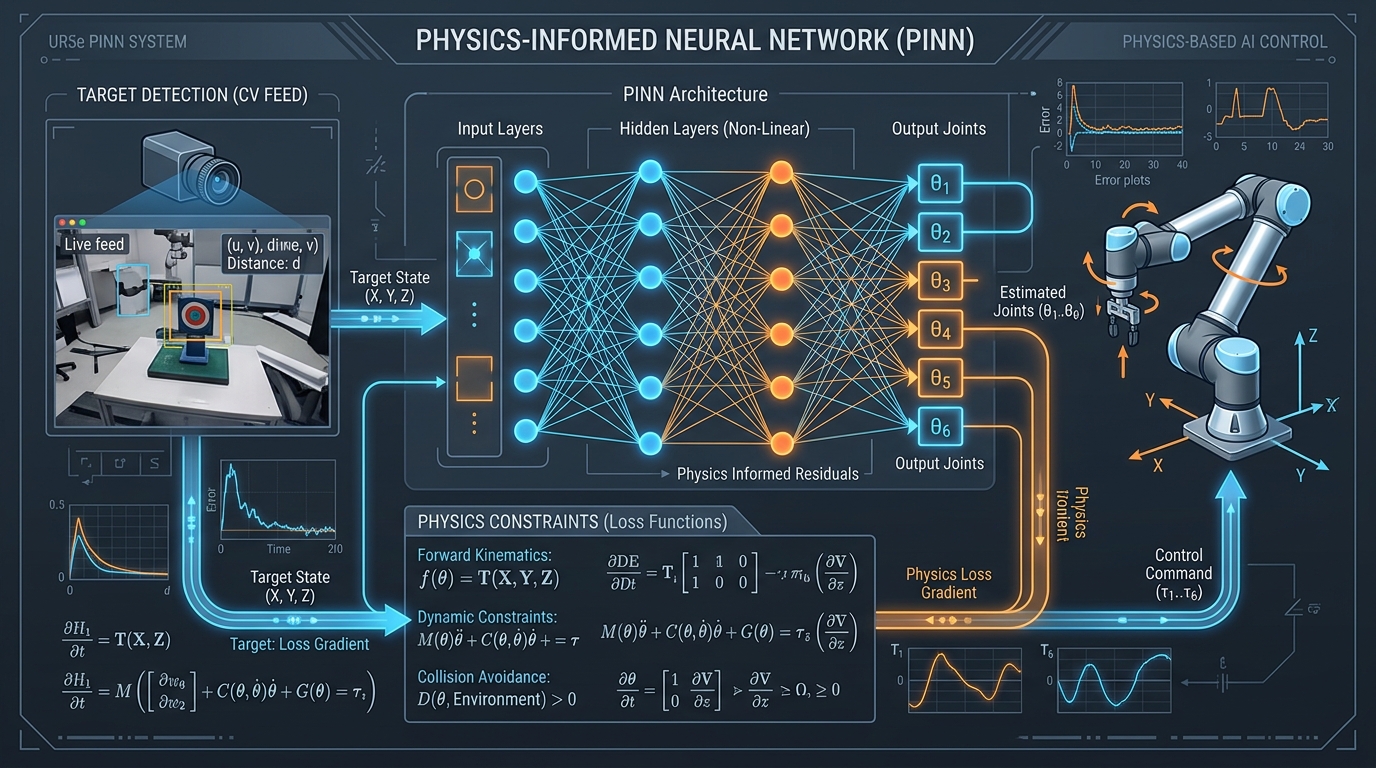
This UC Berkeley robotics project explores inverse kinematics for the Universal Robots UR5e using a True Physics-Informed Neural Network. Instead of treating IK as a purely supervised regression problem, the model is constrained by a differentiable PyTorch forward-kinematics layer so its predictions remain tied to the robot's physical geometry.

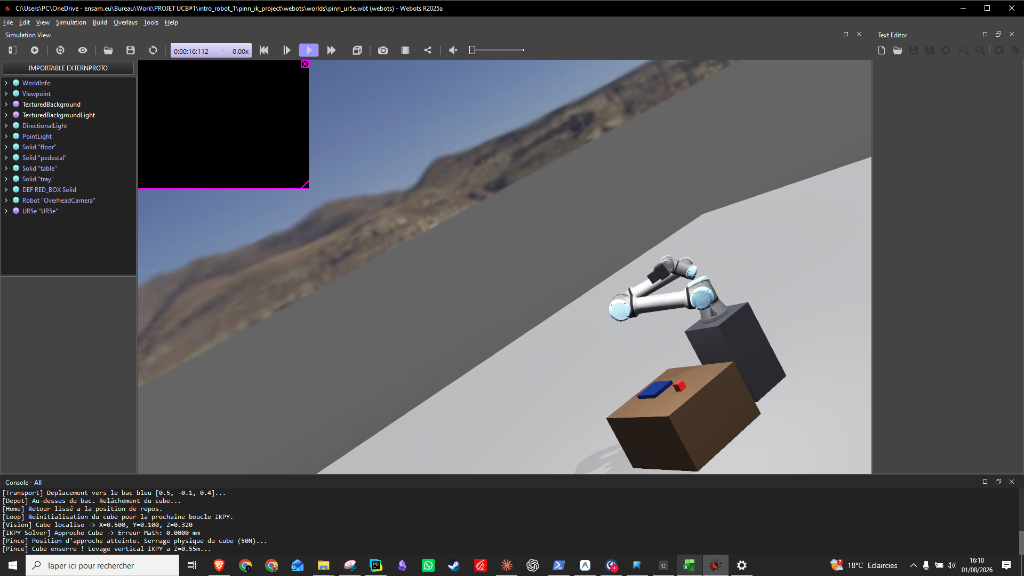
The result is integrated inside Webots: a simulated robot detects a target, predicts a 6-DOF joint configuration, executes a smooth pick-and-place trajectory, and is compared against an analytic IKPY baseline in a side-by-side benchmark environment.

  • PyTorch PINN
  • UR5e forward kinematics
  • Webots simulation
  • IKPY comparison
  • Computer vision target pipeline

01. What it does

A compact IK pipeline that connects target perception, physics-informed joint prediction and robot motion inside a simulated industrial manipulation task.

Pipeline

From target position to smooth robot actuation.

The Webots camera identifies a target object and converts the detection into a Cartesian position. The trained PINN predicts the six UR5e joint angles needed to reach that point, while the controller executes a smooth trajectory and closes the gripper around the object.

Input

3D target position from the simulated perception layer.

Model

Neural IK with a differentiable FK consistency constraint.

Output

Six joint angles executed by the UR5e controller.
Benchmark

True PINN versus analytic IKPY inside the same Webots scene.

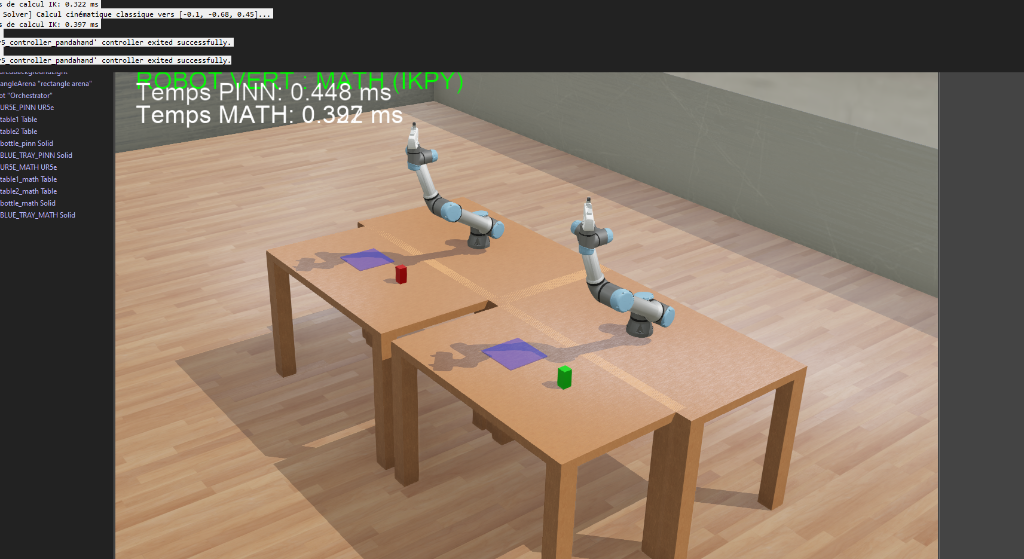
A second simulation world runs two UR5e robots side by side: one driven by the True PINN and one driven by analytic matrix-based IK. The comparison highlights execution time, motion consistency and the branch-flipping behavior that can appear when multiple analytic IK solutions are valid for the same end-effector position.

  • Average compute time: True PINN around 0.35-0.45 ms in the project benchmark.
  • Solution behavior: deterministic and smooth joint predictions.
  • Model property: differentiable pipeline suitable for learning-based robotics work.
Physics-informed neural network architecture diagram

Engineering contribution

The key idea: constrain learning with robot physics.

The project uses a hybrid loss: a data term teaches the model plausible joint configurations, while a physics term checks the predicted joints through a differentiable forward-kinematics model. That makes the neural solver less of a black-box shortcut and more of a physics-aware approximation of the robot's IK behavior.

  • Hybrid data and physics loss
  • Forward kinematics in PyTorch
  • Joint-limit aware prediction
  • Simulation-ready controller path

02. Positioning

Why this belongs in the portfolio.

This project connects mechanical engineering, robotics, simulation and machine learning in a concrete system: geometry-aware learning, robot control, visual target detection and repeatable simulation benchmarking. It fits naturally beside the existing simulation and automation work.